


Juan de la Cuesta´s print shop

(Calle San Eugenio, on the corner of Calle Atocha)

Today this is where the Cervantine Society is located.
Juan de la Cuesta had six moveable type shops, with twenty workers, who ran the graphic and publishing production. More than twelve of Lope de Vega's works were printed here, where the first edition of Don Quixote de la Mancha came into being in 1605, and where other works by essential authors from the Golden Age of Spanish literature were printed.
The church of San Sebastián´s cemetery
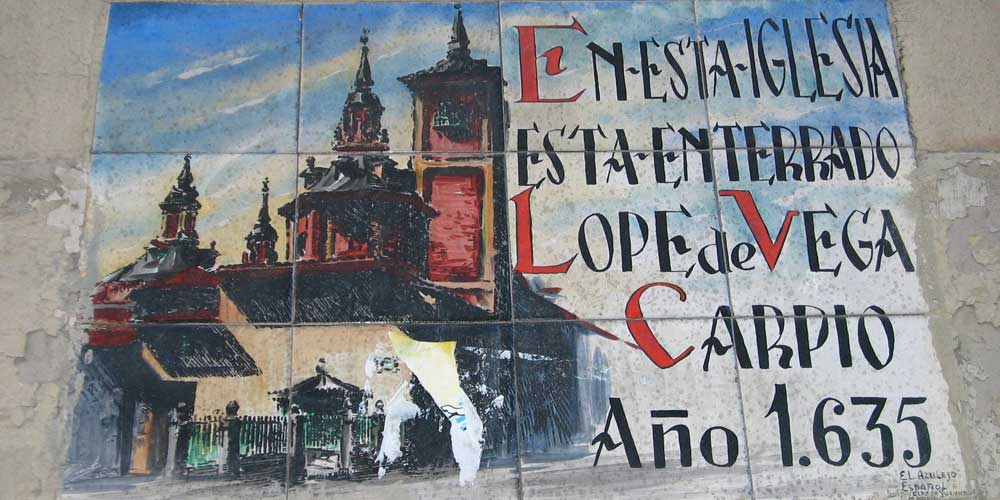
(Calle Huertas 2 on the corner of plaza Ángel)
Today this is a plant nursery.
The custom of the time, until it was prohibited in 1808, was to bury the dead in a cemetery next to the church, with the exception of noble families and the bourgeois, who were entombed in mausoleums or in the floor of the temples. The majority of the actors were buried in the Church of San Sebastián's cemetery, and Lope's remains probably ended up here as well.
Gaming house
(Plazuela de Matute)
In this plaza, very close to the mentidero on Calle León, there was a gaming house run by Antonia Trillo de Armenta, a rich widow with whom Lope had an affair. The poet was processed for public cohabitation with her.
Silversmiths
(Area around Puerta Cerrada)
The silversmiths and silversmith shops of Madrid were located in the area around the Church of San Salvador: in front of the old regional government building, in the expansion of the Calle Mayor where the Mercado de San Miguel is located, and onthe side streets, Milaneses and Santiago.


